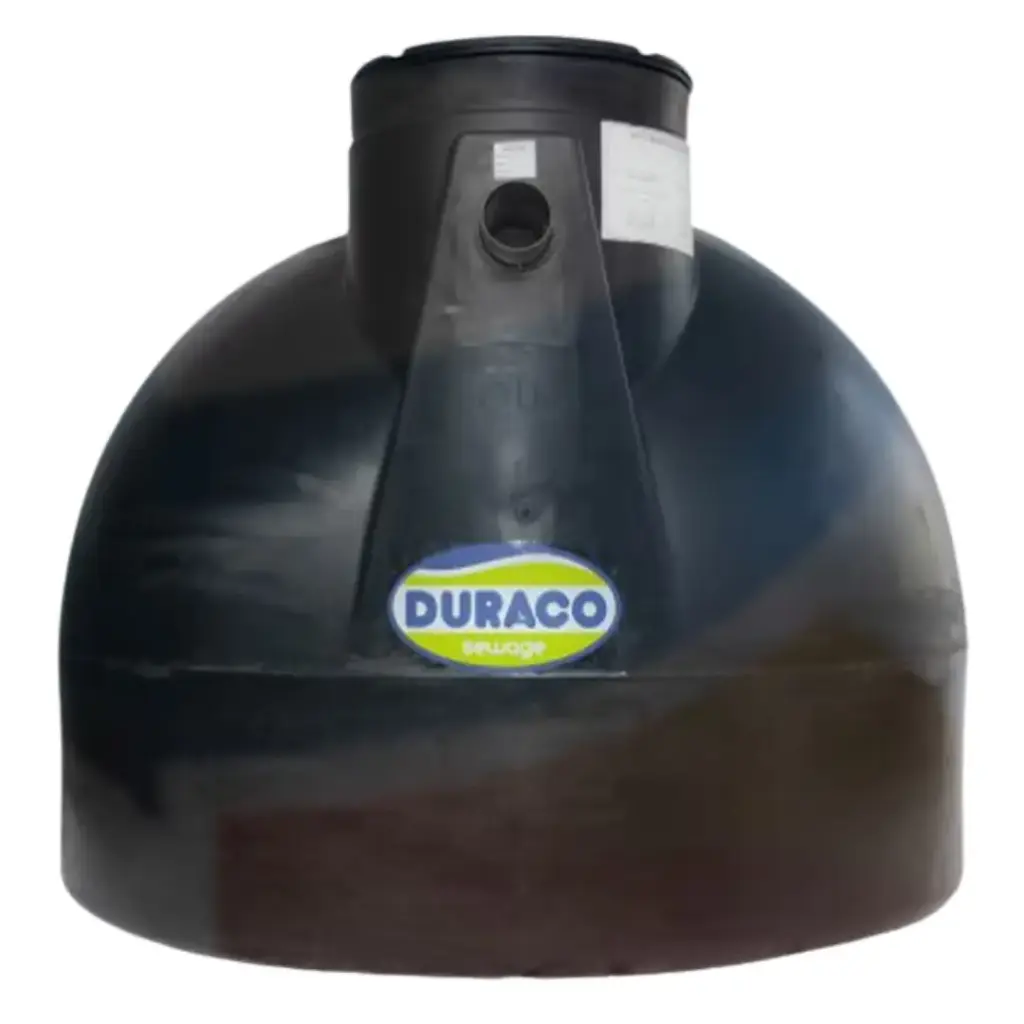
DURACO Septic Tank 3000L
Septic 3000L
Diameter: 1935 mm
Height: 1500 mm
Max Pax: 8
SIZING OF SEPTIC TANKS
Average Waste-water generation per person – 180 Litres/day
Retention Time for Treatment and Reaction – 48 hours (2 days)
Volume Required for Treatment = Volume of Waste-water Generated.
Volume of Waste-water generated in 48 hours = No. of Person x Wastewater Generated Per Person x 2
For example: A family of 5 persons will require a 1,800 L Septic Tank (5 x 180 Lt x 2)
Waste-water (black water from Toilet) enters the septic tank through a 110mm diameter pipe on which a venting pipe (Air Vent) should be connected. For each flush, waste-water flows down through the pipe picking up oxygen through the air vent pipe.
As waste-water enters the septic tank, it is segregated in three segments:
Segment A – Upper part of the septic tank consists of Fats, Oil and Grease (FOGs). In this zone, aerobic bacteria gradually degrade the FOGs.
Segment B – Middle part of the Septic tank is the Aerobic zone consisting of suspended matter, oxygen and aerobic bacteria. In this segment, the organic matter is degraded to form Carbon dioxide and Water. Carbon dioxide diffuse out through the Air vent.
Segment C – Anaerobic zone consist of sludge (mixed of settled solid degradable organic matter and dead cells of bacteria) and anaerobic bacteria. In the anaerobic process, carbon dioxide, hydrogen sulphide, methane and water are formed. These gasses get diffused out through the air vent pipe. The treated water passes through the pre-filter basket into the absorption pit.
INSTALLATION PROCESS
Step 1: Excavation: –
Dig to a depth that will provide a maximum of 300 mm of fine soil over the top of the Septic tank.
Allow 230 mm around the tank.
Step 2: Bedding: –
Allow for a minimum of 150 mm of compacted bedding material rock sand. Bed the rock sand and make sure the surface is levelled. Placed the septic tank on the levelled bed.
The septic tank is supplied with PVC sleeves [internal diameter 110 mm] at the inlet and outlet. The inlet and outlet pipes should be glued to the sleeves using standard PVC glue.
Step 3: Backfilling: –
Ensure the tank lid is properly screwed on the tank manhole. Fill the tank with water through the inlet as you backfill, keeping the water level even with the backfill level. This will prevent possible distortion of the tank and its manhole. Do not remove the lid until the end of the backfill process.
Backfill in layers of 200 mm at a time and properly compact each layer. Ensure to compact each end first. Compact the backfill under the inlet and outlet before fixing the pipes.
Maximum backfill over the top is 300 mm. Mound fine soil over the top to provide positive drainage
NOTE: In case the septic tank needs to be installed with more than 300mm of soil above its top, it must be protected by a heavy-duty concrete slab. THE SLAB MUST REST ON FIRM SOIL AROUND THE TANK
Step 4: Septic Extension: –
In case the manhole screwed lid does not reach the ground level, a septic extension will be required. Install the extension to the manhole outlet before starting the backfill process. Make use of Duraco septic extension EXCLUSIVELY. The screwed lid supplied with septic will fit the septic extension.
Step 5: Leaching Field or Drain Field Material: –
The home sewer drain needs to slope at least ¼ inch per foot downhill to the inlet of the septic and the outlet pipe must cater for a downhill slope of 1/8 inch per foot to the absorption pit. The absorption pit should be at a distance of not more than 3 m from the septic and its volume must be at least similar to that of the septic tank.
This content will be shared across all product pages.
Your Dynamic Snippet will be displayed here...
This message is displayed because youy did not provide both a filter and a template to use.
Explore the Exclusive Limited Time Deals
Your Dynamic Snippet will be displayed here... This message is displayed because you did not provide both a filter and a template to use.